A four-line real estate marketing platform — built, compliant in 51 states, and billing in 24 days
Agents buy their website from one vendor, their listing sites from another, their postcards from a third — and carry the advertising-law risk themselves. NextHaus is the platform that collapses all four into one engine, with the licensing rules of every U.S. jurisdiction encoded as data rather than left to the agent. Built by Motiv Labs, live at nexthaus.co.
first commit to a live, billing platform
jurisdictions in the compliance engine
listing & agent site templates, 7 themes
automated checks across two dozen gate suites
Real estate advertising law is state law, and it contradicts itself across borders — New York bans the word 'group' in a team name, Texas allows 'realty'; California reads 'CA DRE #', every other state reads '{ST} License #'; Texas requires the IABS notice and Consumer Protection Notice at mandated point sizes, New York requires Fair Housing and Standardized Operating Procedure notices, Ohio and Connecticut require update stamps. All 51 jurisdictions live in a single profile registry, and every template, postcard, door hanger, and social image renders that state's requirements inside its own aesthetic — automatically, on every surface.
Overview
NextHaus is Motiv Labs' own product: an AI-first marketing platform for real estate agents, teams, and brokerages, live at nexthaus.co. An agent's marketing is normally assembled from four vendors that don't talk to each other — a personal website here, listing sites there, print collateral somewhere else, and whatever outbound they run themselves — with the agent personally carrying the advertising-compliance risk across all of it. NextHaus makes them one engine drawing from a single source: your listings, your brand, your license. Build it once, and every channel stays consistent and stays legal.
The problem it solves
Three structural problems in how real estate professionals buy marketing, each of which the incumbent tools leave to the agent:
Four vendors, four sources of truth. The same listing gets retyped into a website builder, a flyer template, a social scheduler, and a postcard order — so the price is stale in one place, the license number is missing in another, and nothing matches.
Compliance is the agent's personal risk. Advertising rules are state law and differ in the details — required notices, license-label wording, what may appear in a team name, how prominently the brokerage must appear. Generic design tools render whatever you type. The exposure lands on the licensee.
Priced by the seat, not the work. Per-seat pricing punishes exactly the teams and brokerages that grow, and bears no relationship to what the platform actually does — which is publish and market listings.
Four service lines, one engine
Everything on the platform reads from the same listing, brand, and license data, so a change in one place propagates to every channel:
Property websites. Every listing gets its own site, from a registry of 7 property templates each carrying multiple skins drawn from a 13-palette library — with a shared compliance footer contract that no template can opt out of.
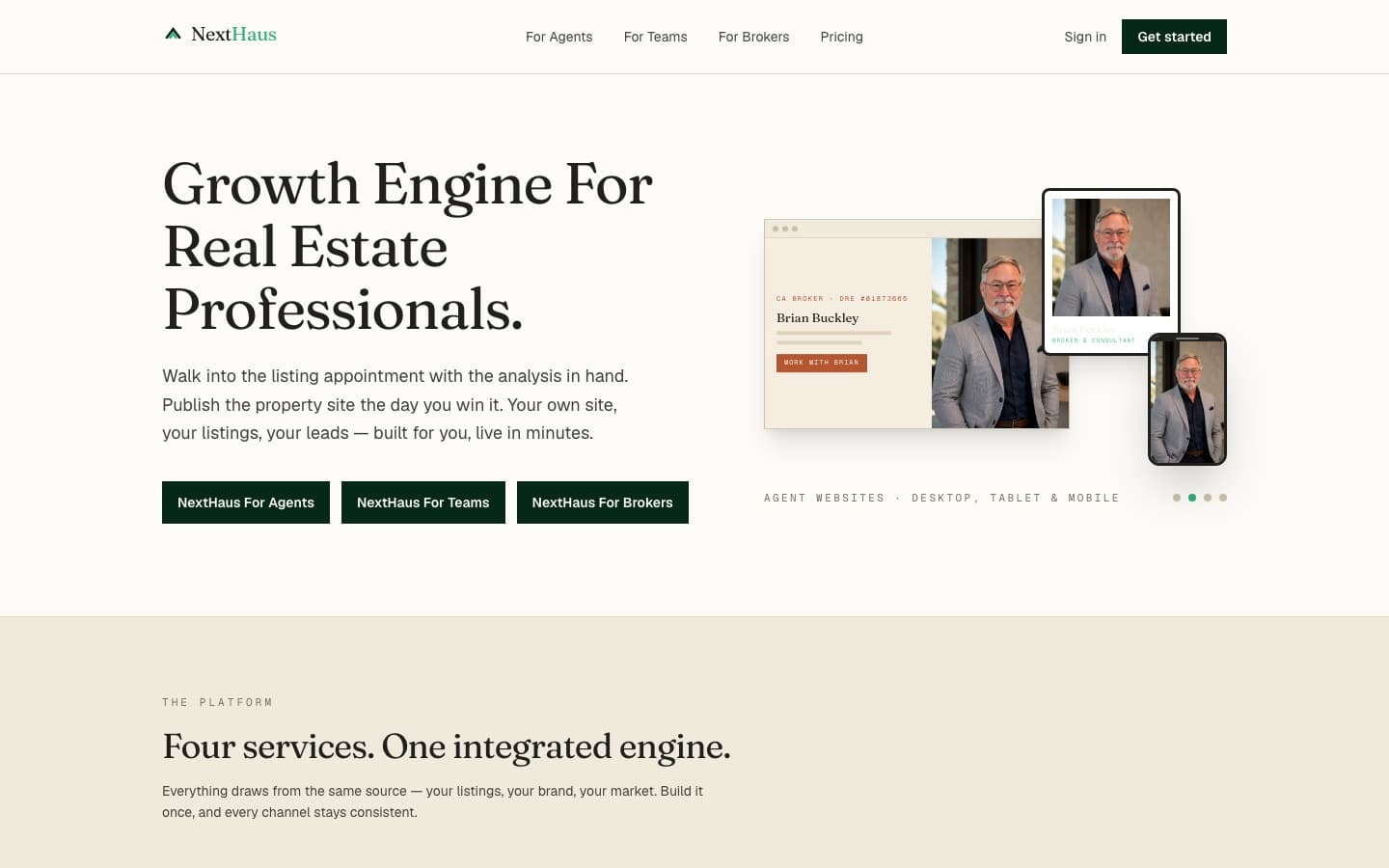
Agent, team & brokerage sites. 13 site templates (6 agent, 7 organization) across 7 themes, with brokerage-specific composition — roster, offices, agent voices, and a recruiting section that renders only when there's recruiting content to show. Tenants on an active plan connect a domain they own, self-serve, with the real DNS records surfaced and nothing marked live until Vercel verifies it.
Market & property analysis. Zip in, printable multi-page bifold market report out — the analysis the agent walks into the listing appointment holding.
Marketing & outbound. A Marketing Hub that generates social images, vertical video, postcards, and door hangers from the listing that's already in the system — with print, email/SMS, and ringless voicemail on an honest roadmap surface where announced-but-unbuilt lines are inert cards, never links to nowhere.
Compliance as an engine, not a checklist
The hardest and most defensible part of the build. Two layers, both automatic:
The jurisdiction registry. All 51 jurisdictions as data — required notices, license-label wording, extra identity lines, staleness stamps — with an unknown state falling back to a strict superset rather than to nothing. A team-name validator catches the contradictory lexicons across state lines and warns rather than blocks.
Verification against the actual state file. License checks run against real state licensing data, and the details matter: Florida publishes two status columns, so a naive single-column check verifies roughly 99,000 licensees who are Current but not Active. California's file is active-only, which makes 'inactive' literally unobservable there, and its 'Licensed NBA' status — 81,000-plus salespersons — means 'no broker affiliation', which is a legitimate state, not a failure. 83,000-plus California brokers have no broker of record because they are one.
One account per license. Enforced by a partial unique index on the normalized state-plus-number pair, not just an application check — because a license number is only unique within a state, and because 'DRE 01975174' and '01975174' must be the same person.
Gated on printing, never on having an account. Signup never rejects a licensee — a typo shouldn't cost someone an account. An account is always created; what's gated is publishing and printing, until the license and broker association check out. Every outcome offers a route forward.
Get the build breakdown — and a plan for your pipeline.
Drop your email and we'll send a full breakdown on how this platform was built.
Real generation, not previews
The generation lines produce actual production artifacts, and the previews an agent sees are the real endpoint output rather than a mockup of it:
Social images. Deterministic compositions across 3 sizes and 4 listing milestones, rendered in the listing site's own palette, with a scannable QR code and the full licensee identity block — name, license, and brokerage rendered in full, wrapping rather than truncating, because an ellipsis in an identity line is a compliance failure. AI-relit or staged photography carries a visible disclosure chip.
Print-ready PDFs. Door hangers and postcards render to a trade printer's measured artwork spec — their die geometry pixel-measured from the real templates, TrimBox and BleedBox declared for preflight, and a separate proof variant with die-line, crop marks, and a 'not for production' banner. Headlines step down and wrap on an uncapped budget; they are never truncated.
Three named typeset styles. Ledger, Hearth, and Signal span the whole kit — postcard front and back, both door-hanger formats, three social sizes — defaulting from the source template's family. The style changes the shape; the compliance and data contracts stay fixed underneath it.
"Make it yours". Agents rewrite the words of any piece — headline, subline, body lines — but never identity or compliance content or listing facts, which have no editable fields by construction. Overrides store only divergence, apply at the last token-building step, and are visible in the preview, both PDFs, the ordered artwork, and the social render with zero per-consumer logic.
Priced by the listing, not the seat
Seats were retired outright — the roster is unlimited within a tier. Plans run $50, $75, and $100 a month with 5, 10, and 15 included active listings, $10 a month per listing beyond that at every tier, annual at two months free, and a $19-per-listing rung for agents who want to pay only for what they publish. Each plan carries org-wide monthly AI pools for rewrites, hero images, stagings, videos, and analyses, with credit packs available past them. Overage is event-driven — a licensed quantity line item syncs on publish, archive, plan change, and subscription webhook, with a nightly sweep to re-converge anything that failed — so the bill is a monthly true-up rather than a meter, and the publish gate blocks only when there's no active plan at all.
How it got built this fast
24 days from first commit to a live platform taking payments is only possible if verification is automated to the same standard as the code. Every subsystem ships with an end-to-end gate script that runs against a scratch Postgres database and a real server: 210 checks across every site template rendered full, demo, and sparse, in every theme; 57 across the collateral styles; 41 asserting print PDF geometry via the actual PDF boxes; 36 proving a copy override survives into the ordered artwork and that resetting restores byte-identical output. Beyond the assertions, every visual artifact gets a perceptual pass — proofs rasterized and eyeballed — which is what caught the identity block overflowing past trim and a headline truncation that assertions alone had waved through. The compliance gate found a shipped gap on day one: three of the original templates had never rendered a state-labeled license number at all.
Want an engine like this?
Book a free setup call and we'll map where automation pays off first.